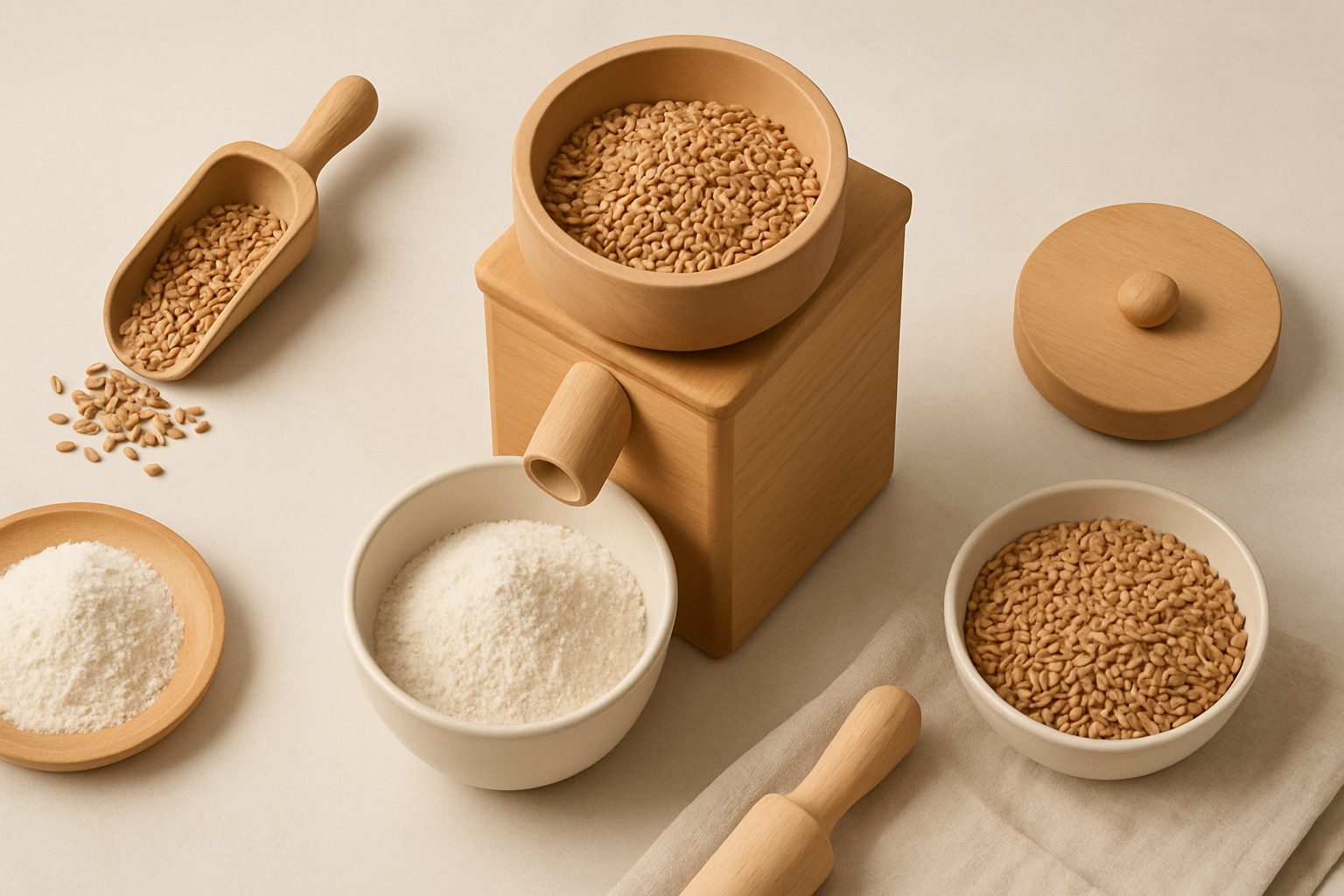
Best Grain Mills for Gluten-Free Flour UK: Rice, Buckwheat & Oat
Milling gluten-free grains at home demands different equipment than wheat. Rice shatters instead of crushes. Oats clog burrs with their starch content. Buckwheat hulls demand gentler handling. Most multipurpose mills struggle with these grains—they either jam, overheat, or produce inconsistent flour. If you're serious about gluten-free milling, you need a mill designed for the job.
Why Standard Grain Mills Fail With Gluten-Free Grains
The problem is material properties. Wheat berries are hard and brittle, ideal for traditional burr mills that apply steady pressure. Rice is harder and denser, requiring higher grinding force. Oats contain more oil and create friction-heat that damages both grain and machinery. Buckwheat hulls are fragile but the grain inside is dense and oily—too much pressure shatters the hull, too little leaves you with unground grain.
Cross-contamination is real concern too. If you've previously milled wheat in a mill, flour dust lingers in impossible-to-reach places: motor bearings, seal gaps, inside the grain hopper. Even thorough cleaning won't eliminate all traces. For coeliac customers or serious dietary need, you may require a dedicated mill.
What Makes Mills Suitable For Gluten-Free Work
Adjustable burr gap: You need fine control to handle grains at different hardness levels. Rice demands tighter gaps than oats. The Osttiroler mills (Austrian-made) and some Salzburg models offer easily adjustable spacing by hand screw—crucial for switching between grains without opening the whole mill.
Modest motor speed: Slower mills (under 1,500 rpm) generate less heat. Fast mills (3,000+ rpm) will scorch oat flour and overheat buckwheat. Stone burrs run cooler than steel, so look for stone or ceramic burr sets when possible.
Stainless steel or sealed components: Oils from oats and buckwheat can gum up wooden or untreated metal parts. Stainless internals resist staining and don't absorb grain oils that become rancid over weeks.
Dust management: Gluten-free grains produce finer, lighter flour dust. A mill without a sealed collection system will create airborne particles—unhygienic and messy. Enclosed hoppers and sealed spouts matter more than with wheat.
The Top Four Dedicated Picks
Komo Komet (Austrian stone burr, 110V): The most reliable choice for serious gluten-free work. Stone burrs run cool, adjustable gap via brass hex screw, motor speed around 1,200 rpm. Stainless burr chamber. Handles oats beautifully without scorching. The learning curve is worth it—you'll need to dial in settings for each grain, but results are consistent. Runs quieter than most. Price point is higher (typically £800–£1,200 online), but resale value holds. Not ideal if you mill large quantities daily; best for weekly 500g–2kg batches.
Osttiroler Rapid (stone burr, variable speed electric): Underrated option. Variable speed control (700–2,000 rpm dial) lets you drop to 800 rpm for oats, raise to 1,200 for rice. Adjustable burr gap by hand screw. Sealed collection hopper. Smaller footprint than Komo. Takes longer per batch than faster mills but produces cooler flour and minimal dust. Solidly built, less polished than Komo. Price around £600–£900. Good middle ground.
OMJ-II or Nutrimill Pro (steel burr, 1,500–1,800 rpm): If speed matters—milling 5+ kg weekly—these mills outpace stone burr alternatives. Steel burrs handle buckwheat hull pressure without wear. Sealed hoppers. Motors run cool enough for oats if you mill in short bursts (2–3 minute intervals, pause for cooling). Cannot adjust burr spacing on most models, so you're locked to "flour" setting. Less flexible than stone burr mills but faster, and steel burrs are replaceable (£80–150). Good for people who prioritise throughput over fine control. Cost £400–£700.
Hawos Novum Bio (stone burr, direct 230V): Simple, compact, German-made. Fixed burr gap, no adjustability. Slower speed (around 1,100 rpm) makes it gentle on oats. Works reliably for consistent grain types. If you'll primarily mill one or two gluten-free grains regularly, the lack of adjustability isn't a penalty—you're not swapping between rice and oats weekly. Sealed hopper. Price region £500–£750. Lower maintenance than motorised competitors.
Cross-Contamination And Storage
If you require absolute gluten-free status, buying a dedicated mill is honest practice. A second-hand mill from another gluten-free baker is safer than a machine that's previously handled wheat. Disassembly and cleaning removes most residue but not all.
Store oat and buckwheat flour in sealed containers—both absorb moisture and turn rancid faster than wheat. Oat flour especially: within four weeks of milling, rancidity develops, particularly in warm kitchens. Freezing extends shelf life to three months.
Final Consideration
Gluten-free milling works best with realistic expectations. Results will be grainier than commercial flour. Buckwheat flour is darker and slightly bitter (expected). Oat flour separates as you mill (normal). Rice flour produces heat—accept slower mill speeds and longer milling times.
Your choice depends on weekly volume, switching frequency between grains, and budget. For occasional bakers, Komo Komet or Osttiroler Rapid offer precision. For regular production, steel burr mills like OMJ-II deliver speed. For simplicity, Hawos Novum works if grain choice stays consistent.
More options
- KoMo Electric Grain Mills (Amazon UK)
- Mockmill Stone Grain Mills (Amazon UK)
- NutriMill Harvest Grain Mill (Amazon UK)
- Manual Hand Grain Mills (Amazon UK)
- Wheat Berries & Milling Grains (Amazon UK)