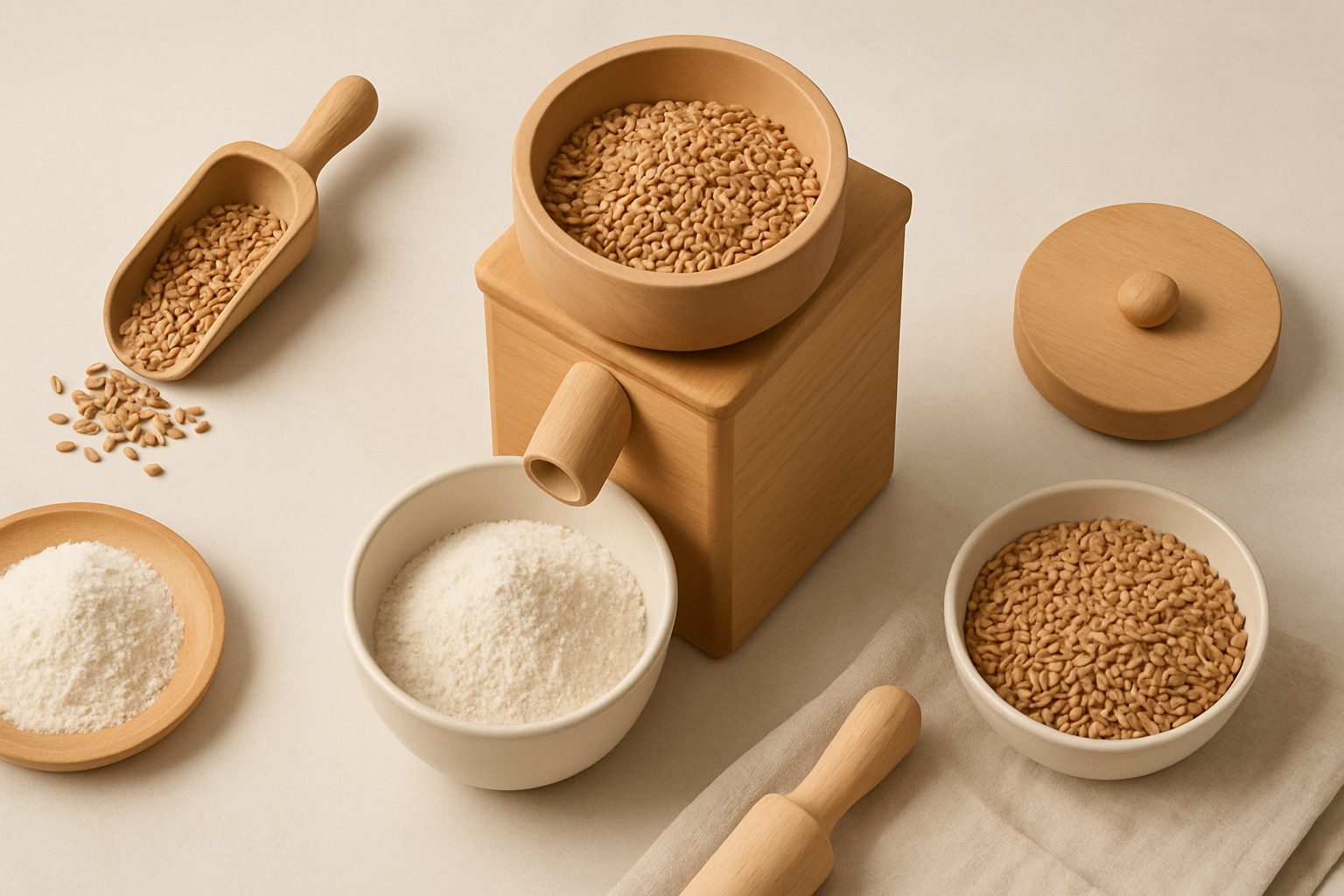
Best Grain Mills for Families & Bulk Milling UK: High-Volume Picks
If you're milling 2 kg or more of grain weekly—whether for sourdough, animal feed, or regular baking—a basic countertop mill will leave you frustrated. Standard hobby mills are built for occasional use, not the consistent throughput families doing serious milling actually need. The motor overheats, the hopper empties constantly, and you're spending 40 minutes to mill what should take 10.
When you're milling regularly, two factors dominate the buying decision: motor durability under sustained use and hopper capacity that actually matches your workflow. A 500 g hopper means reloading 4–5 times for a single bake. A larger hopper lets you mill a batch, walk away briefly, and come back to finished grain. The motor matters just as much. An undersized motor working flat out will fail within a year; one rated for continuous duty will run for decades.
How Much Motor and Hopper Do You Actually Need?
The jump from hobby milling to family-scale milling isn't enormous, but it's precise. If you're regularly processing 2–4 kg per week, you need at minimum a 3 kg hopper and a motor rated for continuous duty—not just "intermittent" duty, which manufacturers hide in the fine print. Intermittent means 10 minutes on, cool down, repeat. Continuous means it can run steadily without overheating.
Look at stones or burrs too. Stone mills produce finer flour but generate more heat and work harder on the motor. Burr mills (usually stainless steel) are more forgiving on sustained runs, which matters when you're doing bulk work.
The other metric is throughput per minute. A mill grinding 100–150 grams per minute sounds reasonable until you do the maths: at 100 g/min, a 4 kg job takes 40 minutes of continuous running. At 200 g/min, it's 20 minutes. That difference determines whether milling feels routine or tedious.
Mockmill Pro: Reliable Mid-Range Workhorse
The Mockmill Pro sits at the sensible middle ground for UK families doing regular milling. It's a stone mill with a 1 kg hopper—small, yes, but the throughput is steady at roughly 120–140 g/min depending on grind coarseness. The motor is rated for continuous duty, which is where many cheaper mills fail. It can genuinely run for an hour without cooling, though most users won't need to.
The appeal is consistency. The Mockmill doesn't pretend to be something it isn't. You reload the hopper every 7–8 minutes for fine flour, accept that, and move on. For a family milling wheat or spelt weekly, this rhythm becomes normal. The stones stay sharp for years if you're patient with coarse grains and don't try to mill oil-rich seeds regularly.
The catch: the 1 kg hopper is the real limitation. If you're the type who wants to set it running and forget it for 20 minutes, this won't satisfy you. Also, stone mills generate more heat than burr mills, so if you're milling soft grains on fine settings, you'll need pauses between batches if you care about nutritional quality (some bakers don't).
Price-wise, it lands around £400–500 depending on supplier, and that's reasonable for the motor quality and reliability record.
KoMo Classic: The Heavyweight Choice
The KoMo Classic is heavier, louder, and considerably more serious. It uses a burr system (steel burrs, not stone) and comes standard with a 2 kg hopper. The motor is again continuous-duty rated, but it's also more powerful—think 180–220 g/min depending on fineness. That's a material difference when you're doing volume work.
The bigger hopper is the real draw for bulk milling. You can load 2 kg, start the mill, and 10–12 minutes later have a full batch of flour without touching it. For families milling several batches weekly, that time savings compounds. You're not reloading constantly; you're milling one batch while preparing the next project.
KoMo mills are German-built with meticulous engineering, which shows in the precision of the burrs and the lack of vibration. They're also noticeably louder than Mockmill—the more powerful motor and heavier construction means audible grinding rather than a gentle hum. If you mill in an open kitchen, your family will know it's running. If you mill in a utility room or garage, irrelevant.
The tradeoff is price and slightly higher maintenance. A KoMo Classic typically costs £550–700 in the UK market. Cleaning the burrs is more involved than with stone mills; you'll need to run through them at least quarterly if you're milling regularly. Not difficult, but it's a thing to factor in.
Value per Kilo: The Real Metric
Where these mills separate themselves from budget alternatives is cost per kilogram milled. A £150 hobby mill might fail after milling 500 kg total. That's £0.30 per kilo just in equipment cost. A £500 Mockmill milling 30,000 kg over its life is £0.017 per kilo. That's the difference between a tool and a toy.
For families committing to regular milling, the rule is simple: buy a motor and hopper rated for what you'll actually do, not what you think you might do once. A family milling 2 kg weekly will run a mill for 100 hours per year. That's not a weekend hobby—that's a utility appliance. Treat the purchase accordingly.
Final Word
Both the Mockmill Pro and KoMo Classic will serve bulk-milling families reliably for 15+ years. The choice between them hinges on whether you prefer smaller, more frequent reloads (Pro) or larger batches with longer run times (Classic). If you're milling grain seriously in the UK, either is a defensible choice. Anything cheaper is a false economy.
More options
- KoMo Electric Grain Mills (Amazon UK)
- Mockmill Stone Grain Mills (Amazon UK)
- NutriMill Harvest Grain Mill (Amazon UK)
- Manual Hand Grain Mills (Amazon UK)
- Wheat Berries & Milling Grains (Amazon UK)