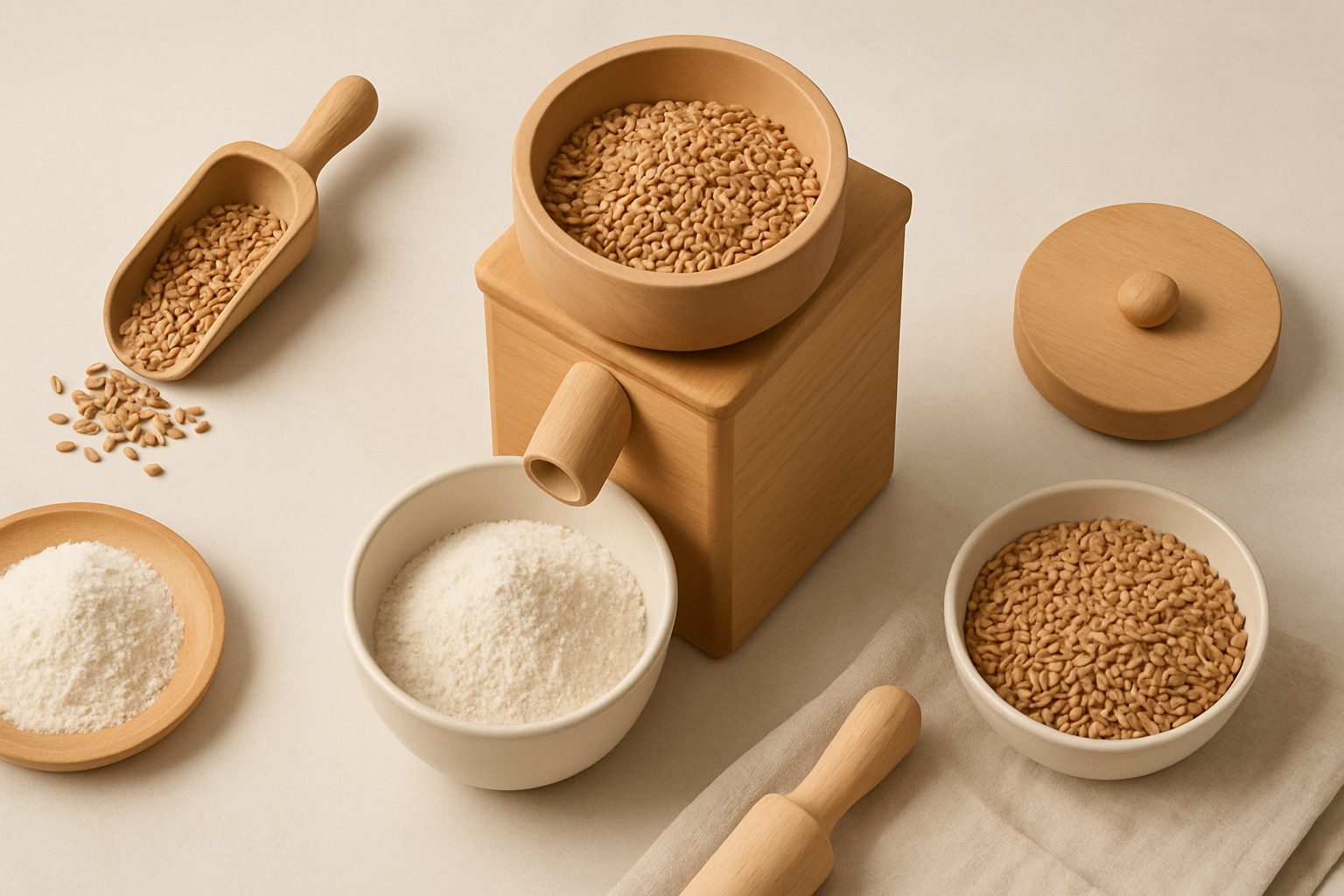
How Fine Can a Home Grain Mill Really Grind? Stone vs Steel Burr Test
If you're thinking about grinding flour at home, the question of fineness matters more than you might expect. It's not just about texture — it affects how your bread rises, how your cakes hold together, and whether you can actually use your flour for the recipes you want to make. So how fine can a home grain mill actually grind? The honest answer depends on your burrs, your expectations, and whether you understand what "fine" actually means.
Understanding Microns: What the Numbers Actually Mean
When milling professionals talk about flour fineness, they're measuring particle size in microns (micrometres). One micron is one millionth of a metre — invisibly small. Flour fineness is typically measured as the percentage of flour particles that pass through a specific mesh sieve, but for practical purposes, understanding the micron ranges tells you what you're dealing with.
Bread flour usually falls between 120–180 microns for the majority of its particles, with many particles finer still. Whole wheat flour, because of its bran content, is naturally coarser — typically 150–250 microns. All-purpose flour sits somewhere in the middle. The finer your flour, the more water it absorbs and the stronger the gluten network tends to become, which is why bread flour — finer and higher protein — produces better rise than coarser wholemeal.
Home mills don't typically advertise their fineness in microns, which makes comparison tricky. Instead, manufacturers describe results as "bread flour fine," "wholemeal," or simply "ground flour." What you're really asking is whether your home mill can achieve those bread flour micron ranges consistently, and the answer is: it depends.
Stone Burrs vs Steel Burrs: The Fineness Factor
The type of burrs in your mill makes a significant difference to the finest flour you can achieve.
Stone burrs — usually made from French buhr stone or similar volcanic stone — can produce genuinely fine flour. Because stone is more porous than steel, it has thousands of tiny grinding edges. As you grind, the stone slowly wears and fractures, continuously creating fresh cutting surfaces. This action is gentler and can produce finer, more uniform flour at slower speeds. Many artisanal mills favour stone for this reason. The trade-off is that stone burrs wear out faster, need regular dressing (an abrasive process to maintain sharpness), and are more fragile. You can't grind metal accidentally into stone flour, but you can crack your burrs if something hard gets through.
Steel burrs — either stainless or hardened steel — are more durable but work differently. Steel grinds primarily through shearing and impact rather than the continuous fracturing action of stone. Most home mill steel-burr designs max out around 150–180 microns for the bulk of the flour, which is respectable for bread, but some struggle below 200 microns. Steel burrs last far longer, are nearly indestructible, and need no maintenance beyond the odd clean. However, they can generate more heat, which concerns some people worried about nutrient loss (though evidence suggests moderate heat doesn't significantly damage grain nutrition for home use).
What Home Mills Realistically Achieve
Let's be specific about what different home mills can do:
Stone-burr mills like the Wondermill or Country Living (both popular in the UK market) can genuinely produce flour fine enough for bread — often reaching that 120–180 micron range consistently. Users report good results with white wheat and spelt, though whole grains produce naturally coarser results because of the bran.
Entry-level steel-burr mills often advertise "flour-milling capability" but in practice produce something closer to coarse meal, particularly on the first run through. Running flour through twice produces finer results but wastes grain. Most settle around 200 microns on a single pass.
Mid-range steel-burr mills with stronger motors and engineered burr design (the Mockmill, for example) achieve finer results — often close to bread flour fineness, though not quite as uniform as stone.
The problem with most home mills is consistency. Commercial mills maintain precise burr distances and produce uniform flour; home mills, even expensive ones, have wider tolerances. Your flour might be fine one batch and coarser the next, depending on feed rate and moisture content.
Testing Your Mill's Fineness
The easiest practical test: grind a small sample, then make bread or biscuits. Bread made from flour that's genuinely bread-flour fine will have noticeably better rise and crumb structure than bread from coarser flour. If your loaf stays dense and squat, your flour wasn't fine enough for bread — though it's perfectly useful for porridge, pancakes, or wholemeal goods where coarser texture is expected.
A more rigorous test involves making a simple water paste with your flour: finer flour feels silkier, absorbs water more evenly, and feels like talcum powder rather than fine sand. Coarser flour feels grittier and takes longer to fully hydrate.
When Home Mills Aren't Enough
If you're grinding exclusively for bread baking and you want consistent, perfectly fine flour, a quality stone-burr mill is your best bet — but expect to spend £200–400 for reliable fineness. Steel-burr mills are cheaper and more convenient but come with the caveat that fineness sits on the edge of "adequate for bread" rather than "definitely ideal."
If you need very high volume or absolute consistency, commercial mills are genuinely the answer, though that's outside the home-milling sphere.
Most people find that a home mill producing 150–180 micron flour works brilliantly for everyday baking, pancakes, and all manner of home cooking. The fineness is good enough, and the flavour and freshness of freshly milled grain easily compensate for flour that's marginally coarser than supermarket bread flour.
Your choice of burrs and realistic expectations about fineness will determine whether your home mill becomes a kitchen staple or a novelty that gathers dust.
More options
- KoMo Electric Grain Mills (Amazon UK)
- Mockmill Stone Grain Mills (Amazon UK)
- NutriMill Harvest Grain Mill (Amazon UK)
- Manual Hand Grain Mills (Amazon UK)
- Wheat Berries & Milling Grains (Amazon UK)