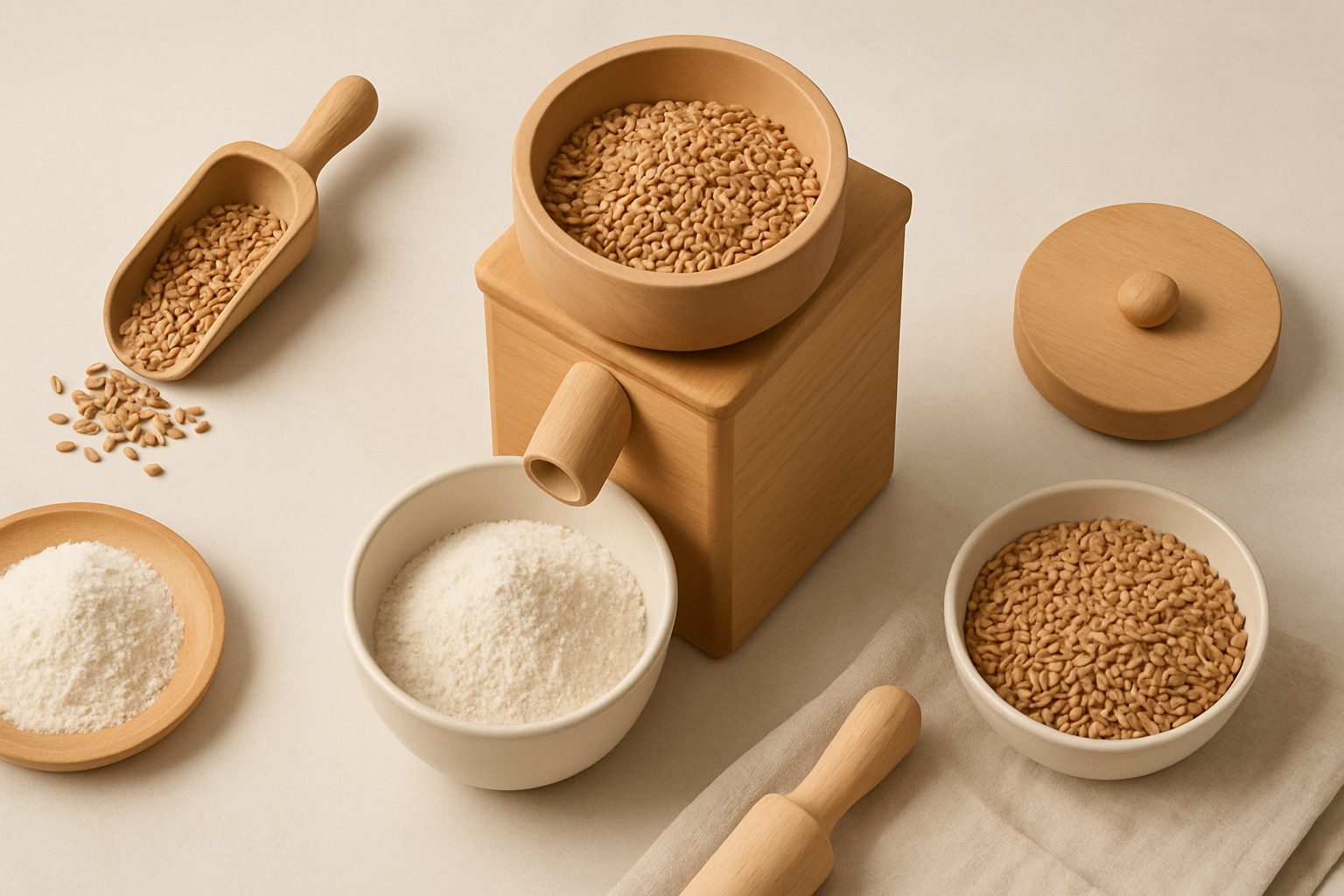
NutriMill Harvest Review UK: Is It Worth the Price in 2026?
The NutriMill Harvest sits at the premium end of home grain mills, and after several months of regular use, it's easy to see why. This isn't a budget entry-point mill—it's pitched at serious home bakers and those who mill flour regularly. Whether that price premium translates to genuine value depends on your priorities and how much flour you actually plan to grind.
Design and Build Quality
The Harvest is a compact mill with a brushed stainless steel body and a substantial feel you don't always get at this price point. It's distinctly American in design (shipping takes 6–8 weeks from the US), but it runs on UK 230V without any adapter needed—NutriMill handles dual voltage internally. That's a practical detail that matters when you're investing £400+ in a machine.
The hopper sits on top with a simple twist-lock mechanism; the grinding chamber is sealed, which keeps flour dust contained during operation. Controls are minimal: an on/off button and a dial to adjust the grind fineness. It's refreshingly straightforward. There are no digital displays, no preset buttons, just mechanical simplicity. Some will see that as clean design; others might want more feedback about what's happening inside.
Grinding Performance
This is where the Harvest earns its reputation. The milling mechanism uses a stone burr system (not blade choppers), which produces remarkably consistent flour texture. Grinding soft wheat berries yields a fine, floury result with good protein development when you're after bread flour. Hard grains like spelt or kamut mill smoothly without jamming, and the flour comes out noticeably warmer than from some cheaper mills, suggesting efficient heat generation—which can actually benefit dough development if you're watching fermentation temperatures closely.
I've ground everything from common wheat to heritage varieties, and the mill handles them all without complaint. The fineness dial has a genuine range: coarser settings are actually useful if you want cracked grain for porridge or animal feed, whilst the finest setting produces talc-like flour.
Noise Levels
This is where you need honest expectations. The Harvest is loud. Not "unbearable" loud, but it's a sustained 80–85 decibels during operation—roughly the volume of heavy traffic. If you're milling early morning and your neighbours are close, they'll hear it. There's no way round this: stone burr mills of this size are inherently noisy machines. Some users have reported success placing it on a rubber mat or inside a wooden box, which can dampen the sound by a few decibels. If noise is a deal-breaker, know it upfront.
Capacity and Hopper
The hopper holds 1.8kg of grain, which is substantial. For most home bakers, that's two to three weeks of milling, depending on how often you bake. The grinding chamber itself is generously sized, and the mill will happily run through a full hopper without stalling or overheating. That said, if you're milling more than 4–5kg of flour per week, you'll be doing this in batches, which is fine but worth acknowledging.
The output chute directs flour into whatever bowl or bag you place underneath. No fancy catch tray, just gravity. It's simple and effective, though flour dust does escape slightly during transfer, so you'll want to work in a kitchen with decent ventilation.
UK Voltage and Power
One genuine advantage: the Harvest works straight out of the box on UK mains electricity. No step-down transformer needed. The motor is solid and doesn't hesitate under load. That said, you'll need a dedicated circuit if you're running it frequently; plugging it into a shared outlet with other heavy appliances can trip RCDs. Just plan accordingly.
Pros
- Consistently fine, even flour from the stone burrs
- Dual voltage; no adapter needed
- Large hopper reduces frequent refilling
- Robust build quality and motor
- Good range of grind settings
- Excellent for heritage and specialty grains
Cons
- Expensive (£400–480 depending on timing)
- Genuinely loud during operation
- Long shipping from the US
- No flour pre-heating or cooling options
- Basic controls mean no precision timing between batches
- Requires decent counter space (roughly 25cm wide)
Who Should Buy This?
This mill suits home bakers who mill flour weekly or more, want consistent results, and can tolerate noise. It's overkill for someone grinding twice a month. It's equally overkill if you're primarily milling grains for animal feed or porridge—a cheaper mill will do that job. But if you're serious about fresh flour for bread, pastry, and baking, and you've already tried cheaper alternatives and found them slow or inconsistent, the Harvest makes sense.
Final Verdict
The NutriMill Harvest is a capable, durable mill that delivers what it promises: quality flour and years of reliable service. The price is high, but it's not exploitative for what you're getting. The question isn't whether it's a good mill—it is—but whether it's good value for you. If you mill flour regularly and want consistency without fiddling, it's worth the investment. If you're shopping for a first mill or use it infrequently, start cheaper and upgrade only if you genuinely hit the limitations of what you buy.
More options
- KoMo Electric Grain Mills (Amazon UK)
- Mockmill Stone Grain Mills (Amazon UK)
- NutriMill Harvest Grain Mill (Amazon UK)
- Manual Hand Grain Mills (Amazon UK)
- Wheat Berries & Milling Grains (Amazon UK)